Justin Davis

Interactive video games have become commonplace. Research into the potential prosocial effects of this media has been a relatively new development. Minecraft: Education Edition features lesson plans that educate participants on a variety of topics, including prosocial behavior. Video games have been around since the middle of the 20th century, but research into this media has not kept up with technological developments. Research into the possible prosocial effects of video games on participants is comparatively sparse to academic literature concerning violent video games and antisocial effects. This thesis will address the following research question: Can Minecraft: Education Edition, through the implementation of lesson plans on empathy and cooperative gameplay, increase in prosocial behavior?
Greitemeyer, et al. (2010) explore how to measure his phenomena. They experiment with dropping pencils and engaging in scripted hostile situations with participants, and conclude that those who played prosocial games reacted more pro-socially to the situations than the control group. Greitemeyer, et al. (2010) also studied how playing prosocial video games related to empathetic and antisocial reactions towards others in their article titled Playing prosocial video games increases empathy and decreases schadenfreude. The prosocial video game players displayed higher levels of empathy and lower levels of schadenfreude toward historic and popular figures than the control group.
"Can Minecraft: Education Edition, through the implementation of lesson plans on empathy and cooperative gameplay, increase in prosocial behavior?"
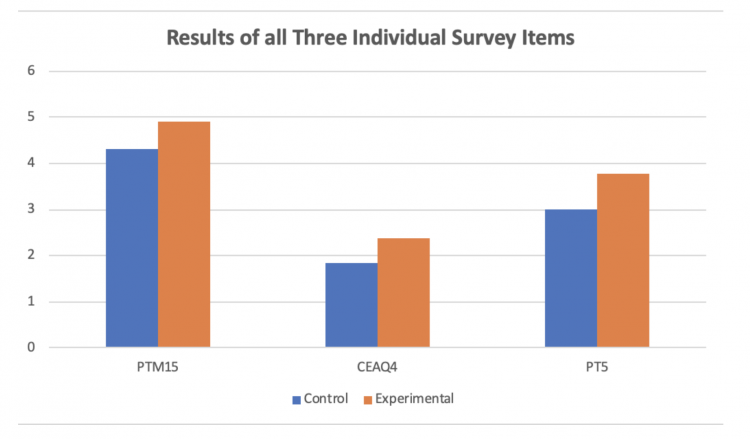
Comparison of experimental and control groups on 3 different measures of prosocial tendency and empathy
Bachen, et al. (2007), analyzed the title REAL LIVES, a video game where players live the life of another person in another part of the world, and studied the effect it had on promoting global empathy and learning. The authors conclude through research that REAL LIFE inspires students to better empathize and identify with separate cultures beyond their own, as well as grow their interest in learning about other countries. Furthermore, Funk, et al. (2008) discuss the development of a 16 prompt questionnaire that was designed to meaningfully identify antisocial behavior patterns with adolescents in order to intervene before they act out in dangerous and illegal activities, as well as identify prosocial tendencies in participants.
Finally, Harrington, et al. (2016) conducted research on the possible prosocial benefits of playing video games. They recruited 538 students aged 9 to 15 and measured their prosocial reactions to playing videos games using various surveys. They conclude that there is a significant relationship between playing prosocial video games and cooperation and empathy.
This thesis will include research on prosocial video games effects on behavior by having two groups play Minecraft: Education Edition. The first group will play an empathy lesson plan, and the second will play the game without direction or overarching goal. These groups will play the game for one hour once a month for three months to gather sufficient data. The Children’s Empathic Attitudes Questionnaire (CEAQ) survey will be administered to both groups after each session, and results will be analyzed to discover discrepancies and patterns.
Access the full document here.