Amy Gibbs

K-12 teachers can enhance their skills and classrooms by participating in professional development, a form of education that can be an hour-long class or weeks-long workshop. All public school teachers are required to complete a number of professional development hours within a specified timeframe, and those opportunities vary based on different schools’ and districts’ policies (Professional Development for Teachers, n.d.).
Although students have more access to technology than ever before, digital literacy pedagogy is still relatively undefined and inconsistently executed. This is largely due to some key barriers teachers face in the successful integration of tech. Studies have shown that the strongest barriers are teachers’ comfort and skills with technology (Ertmer et al., 2012), access to professional development associated with technology use (Blackwell et al., 2013), and skepticism about the effectiveness of technology in the classroom (lnan & Lowther, 2010), to name a few. And although today’s students have grown up with technology, they are not born with digital literacy skills. Rather, those must be taught incrementally over time through age- and grade-level appropriate methods, just like other core subjects.
"This project focuses on the development of innovative professional development program elements that helps teachers understand why digital literacy is an important skill set for students, feel comfortable teaching it, and be able to implement it successfully into their classroom curriculum.
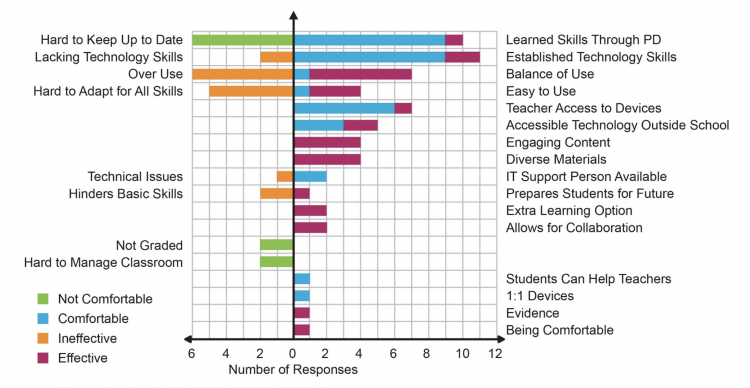
In today’s workplace, technology is commonly used and individuals who have learned about digital technology have not only gained important knowledge, but also other valuable skills. Studies show that technology taught in classrooms encourages students to solve problems, gather information, and learn better communication (Pianfetti, 200 I).
Studies also show that teachers are able to master new skills if they have 50 to 80 hours of training, practice, and coaching, and if they are coached through the process of implementing new skills, 95% can apply that skill into their classroom (Teaching the Teachers: Effective professional development, n.d.). To maximize teachers’ ability to effectively learn and implement new strategies in their classrooms, the following program elements have proved to be necessary: robust and focused content, active learning methods, a collaborative environment, and a connection with the school’s curriculum (Badri, 2016).
Additionally, the timing of professional development should be tailored to teacher’s needs. Teachers prefer flexibility and convenience during the school year; so online options often work better. Lessons from professional development are most successful when teachers can immediately implement what they learned into their classroom (5 Things Teachers Want in Professional Development, n.d.).
The structure of a professional development workshop or class and its content are important factors when it comes to efficacy. Teachers find that a social environment that includes other teachers from different backgrounds and locations is helpful in learning. Teachers trust teachers and prefer their professional development be taught by those who know the content and have experience teaching it to students. All teachers have unique challenges in their classrooms and need the content they learn to be flexible so they can easily apply and modify it as needed (5 Things Teachers Want in Professional Development, n.d.).
To address these concerns, this project will focus on the development of innovative professional development program elements that will help teachers understand why digital literacy is an important skill set for students, feel comfortable teaching it, and be able to implement it successfully into their classroom curriculum.
Access the full paper here.